Gulf countries 'hostages of American policy in Middle East’: Russia tells UN
Russia has accused Gulf countries of being 'hostages' to American policy in the Middle East during a UN discussion, emphasizing the complexities of regional geopolitics.
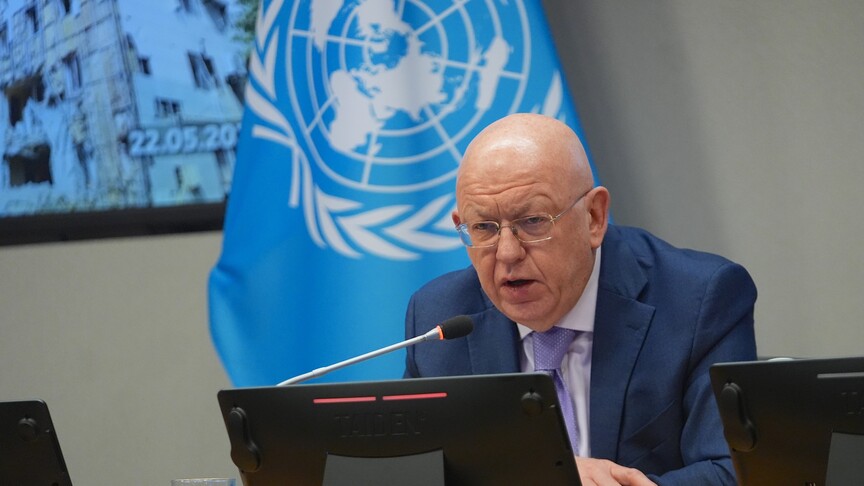
During a recent press conference at the United Nations headquarters, Russia's UN envoy Vassily Nebenzia expressed strong criticism of a US-led draft resolution concerning the Strait of Hormuz. He described the proposal as "one-sided" and argued that it fails to adequately address the origins of the ongoing regional tensions.
Critique of the US-Led Resolution
Nebenzia emphasized that the draft resolution, which was announced by the US in collaboration with Bahrain and Gulf nations including Saudi Arabia, the United Arab Emirates, Kuwait, and Qatar, does not consider the initial causes of the crisis. "Now the Gulf countries, who we sympathize with, they are all our friends. The Strait of Hormuz, the attacks on these countries, we condemn the attacks on the civilian infrastructure," he stated. However, he noted that without acknowledging how the situation escalated, the resolution misses its mark. "Basically, that's why we are not very much enthusiastic to adopt (it)," he added.
Concerns Over Maritime Security
Nebenzia also highlighted the significance of maritime security and freedom of navigation, pointing out that Russia itself has faced challenges in this regard. "The freedom of navigation is very important. We are suffering from the lack of freedom of navigation ourselves because our ships are often stopped arbitrarily, in the open seas, by our former European partners," he explained. He mentioned that Russia, in conjunction with China, has proposed an alternative initiative at the UN Security Council.
Warnings About Regional Escalation
Addressing the escalating tensions involving Iran and US military presence in Gulf states, Nebenzia cautioned about potential wider repercussions. He noted that Iran had previously warned that it would target US military infrastructure in the region if hostilities arose. "I'm telling them: you are the hostages of the American policy in the Middle East," he asserted, reiterating a long-held view that such crises are inevitable for the Gulf countries, regardless of their willingness to engage.
Nebenzia concluded his remarks by criticizing the International Atomic Energy Agency's approach, accusing its director general, Rafael Grossi, of avoiding the core issues at hand, which he described as stemming from "unprovoked aggression."
Source: aa.com.tr